
Custom Training
Custom training solutions that align talent development with business strategy. To learn how NJIT's Learning and Development Initiative (LDI) can help you please contact us today.
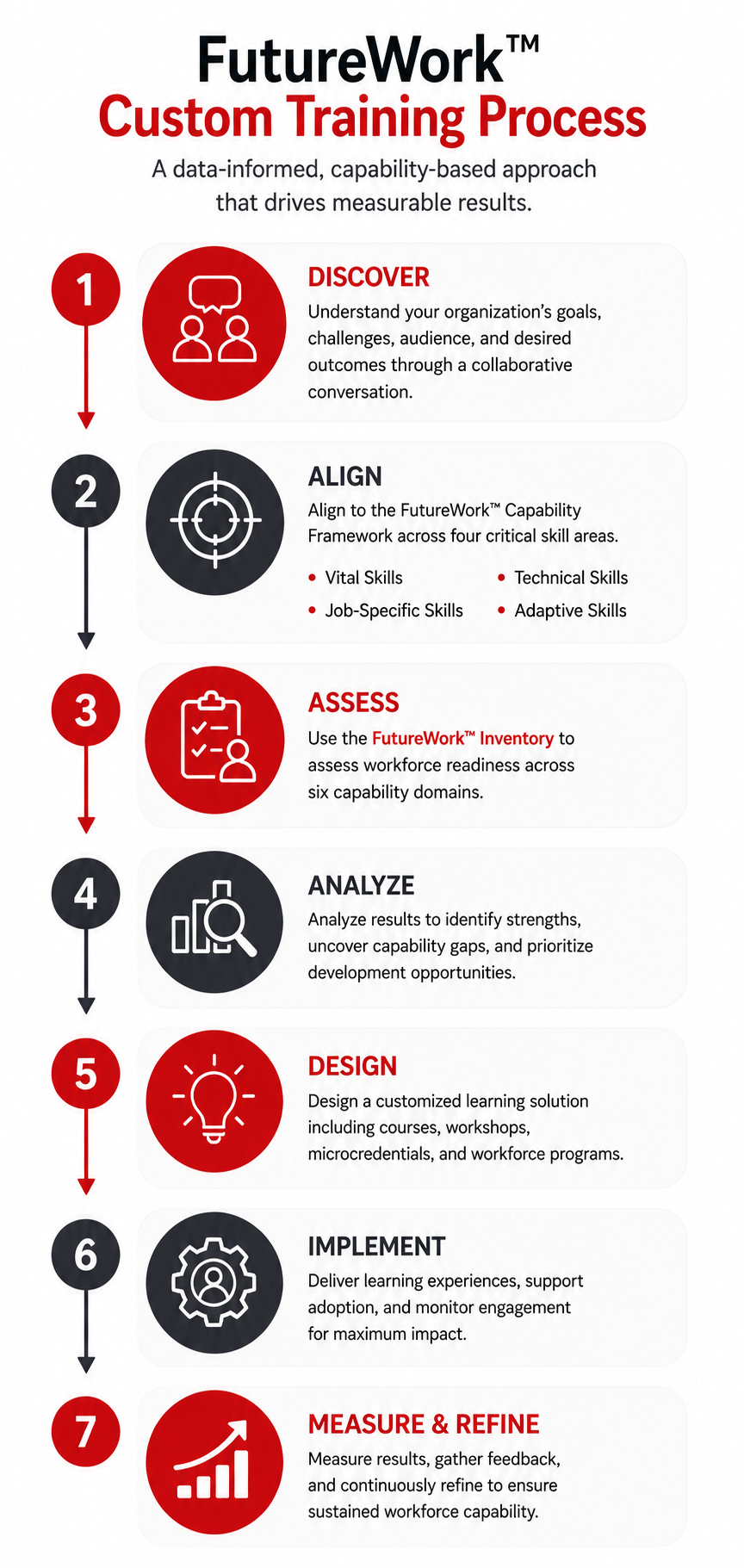
NJIT's professional education and non-credit division, The Learning and Development Initiative (LDI), is a key partner for companies, non-profit organizations, and government agencies seeking to upskill, reskill, or skill their employees. In order to remain vital, vibrant, and relevant in today's hyper-competitive marketplace, organizations rely on the LDI's unique proven approach to custom training. The image below illustrates the five step process that highlights how the center of all of our training programs is the client and their specific needs.
Because growth doesn’t happen by chance—it happens by design.
For more information and to register for the AI Practioner course, please click here.
Explore the following 10 reasons to understand why many organizations struggle to train and upskill their employees effectively—and how forward-thinking leaders can reverse these trends.
10 Reasons Why Organizations Fail to Train Their Employees
Intro — The Cost of Neglecting Employee Development
Response: Many organizations underestimate how training drives innovation, retention, and adaptability. Without continuous learning, skills erode, morale declines, and competitiveness fades. Investment in people is not a perk—it is a prerequisite for long-term performance. When leaders frame training as an expense instead of a strategic asset, they unintentionally limit growth and resilience.
Resource: World Economic Forum (2025), The Future of Jobs Report 2025 — Read the report
1. Lack of Strategic Alignment
Response: Training often fails because it operates independently from organizational goals. When learning objectives don’t connect to performance metrics, executive support wanes and participation drops. Effective programs translate business priorities—like innovation, safety, or customer satisfaction—into measurable learning outcomes. Alignment ensures training contributes directly to mission success.
Resource: McKinsey (2025), The Future of the CLO: Leading in a World of Merged Work and Learning — Read the article
2. Short-Term Thinking
Response: Leaders under quarterly pressure may cut or delay training budgets, viewing learning as optional. This short-term mindset undermines talent pipelines and future capacity. Organizations that treat training as a recurring investment, not a one-time event, build the agility to respond to disruption and opportunity alike.
Resource: Deloitte (2025), 2025 Global Human Capital Trends — View insights
3. Absence of Leadership Buy-In
Response: When executives or managers fail to champion professional development, employees perceive training as irrelevant. Visible endorsement from leadership signals that learning matters. Champions model curiosity and reinforce application on the job, turning training into culture rather than compliance.
Resource: Harvard Business Review (2016), Why Leadership Training Fails—and What to Do About It — Read on HBR
4. Insufficient Needs Assessment
Response: Many programs launch without understanding actual skill gaps or workforce goals. Without data, training becomes generic and disconnected from real work. Needs assessments—through surveys, analytics, and observation—create targeted, high-impact learning paths that respect employee time and deliver measurable outcomes.
Resource: ATD (2024), The 5 Must-Haves of Needs Assessment — Read the guide
5. Overreliance on One-Time Events
Response: Workshops and webinars create awareness but rarely change behavior by themselves. Continuous learning requires reinforcement, reflection, and practice. Microcredentials, coaching, and spaced learning sustain engagement and translate insight into performance improvement.
Resource: LinkedIn Learning (2025), Workplace Learning Report 2025 — Download report
6. Failure to Integrate Learning into Workflows
Response: Training detached from daily operations feels like an interruption. Integrating short modules, digital resources, and peer collaboration into regular workflows allows learning to happen in real time. The closer training sits to the point of need, the higher its adoption and impact.
Resource: Deloitte (2024), Upskilling at the Point of Need: Embedding Knowledge in the Flow of Work — Read the insight
7. Inadequate Measurement and Feedback
Response: Without metrics, organizations cannot prove training effectiveness. Many rely solely on attendance rather than behavioral or performance outcomes. Feedback loops—tracking application, results, and ROI—build credibility and enable continuous program refinement.
Resource: Kirkpatrick Partners, The Kirkpatrick Model (Four Levels) — Learn the model
8. Ignoring Culture and Psychological Safety
Response: Employees avoid training when fear of judgment outweighs curiosity. A culture that values experimentation and learning from mistakes unlocks participation. Psychological safety turns learning from obligation into opportunity, especially during technological change.
Resource: Center for Creative Leadership (2024), What Is Psychological Safety at Work? — Read the article
9. Lack of Time and Manager Support
Response: Even motivated employees cannot learn without time or encouragement. Managers who protect learning time and recognize application outcomes foster engagement. Scheduling flexibility and visible rewards make development feasible amid competing demands.
Resource: SHRM (2025), Aligning Learning & Development With Evolving Workforce Needs — Read the feature
10. Resistance to Change
Response: Change fatigue and fear of obsolescence cause many to resist training. Transparent communication about purpose, benefits, and career pathways reduces anxiety. When employees understand how learning supports—not threatens—their growth, participation rises and transformation accelerates.
Resource: MIT Sloan Management Review (2024), Strengthen Your Change Muscle for Competitive Advantage — Read the analysis
Conclusion — Turning Barriers into Building Blocks
Response: Organizations that diagnose and address these ten barriers convert inertia into momentum. Aligning training with mission, leadership, and culture turns development into a competitive advantage. In a rapidly evolving economy, learning is no longer supplemental—it is survival strategy.
Resource: OECD, Getting Skills Right: Skills for Jobs Indicators — Explore methodology & data